

Partner with
The Social Sustainability Project…
Be a driving force in the Lived Experience and Social Sustainability Landscape
Big ideas, real impact….
Partner With
The Social Sustainability Project
Building the next investment space: Social Sustainability
The Social Sustainability Project exists to design, test, and scale practical solutions to structural harm.
We work at the intersection of lived experience, research, business, technology, community infrastructure, and systems reform. Our focus is not simply to describe what is broken. Our work is to build what comes next.
Australia spends billions every year responding to crisis: policing, prisons, child protection, homelessness, emergency healthcare, family violence, disability system failure, unemployment, addiction, mental distress, and social disconnection.
Too much of this spending happens after harm has already occurred.
We believe the next generation of social investment must move upstream.
It must support community-owned infrastructure, early intervention, place-based enterprise, lived-experience-led research, practical prevention, and technology that helps people be understood before they are classified, excluded, criminalised, or pushed further into crisis.
This is Social Sustainability.

What We Are Building
The Social Sustainability Project is developing a portfolio of practical, investment-ready and partnership-ready initiatives designed to move communities beyond crisis management and into prevention, participation, ownership, and repair.
Our work is grounded in a simple premise: social harm is expensive, and the people closest to the problem often hold the clearest intelligence about what needs to change.
We are building models that combine lived experience, research, technology, enterprise, and community-owned infrastructure to create measurable social, economic, and public-interest returns.
-
Place-based infrastructure designed to return economic, social, and decision-making power to local communities.
This includes community-led spaces, local enterprise hubs, shared facilities, social housing-adjacent infrastructure, food systems, wellness spaces, and practical support models that strengthen communities before crisis takes hold.
The goal is not simply service delivery. The goal is community capacity, local ownership, and long-term social repair.
-
Structured research, reports, case studies, policy analysis, and resource development grounded in lived experience and translated for professional, institutional, and public audiences.
We help turn lived knowledge into clear, credible, usable material for policy, advocacy, funding, service design, social impact reporting, and systems reform.
This work recognises lived experience as intelligence — not anecdote, not complaint, and not background noise.
-
Technology has the potential to help people be understood before they are dismissed, excluded, pathologised, or criminalised.
We are developing AI-assisted tools that help translate lived experience into clear language for reports, applications, advocacy documents, policy submissions, case studies, service design, research, and public communication.
In Australia, people often speak multiple dialects of English in the same community: trauma language, street language, service language, legal language, academic language, policy language, and family language.
AI can help bridge those gaps when it is used ethically, carefully, and in the public interest.
-
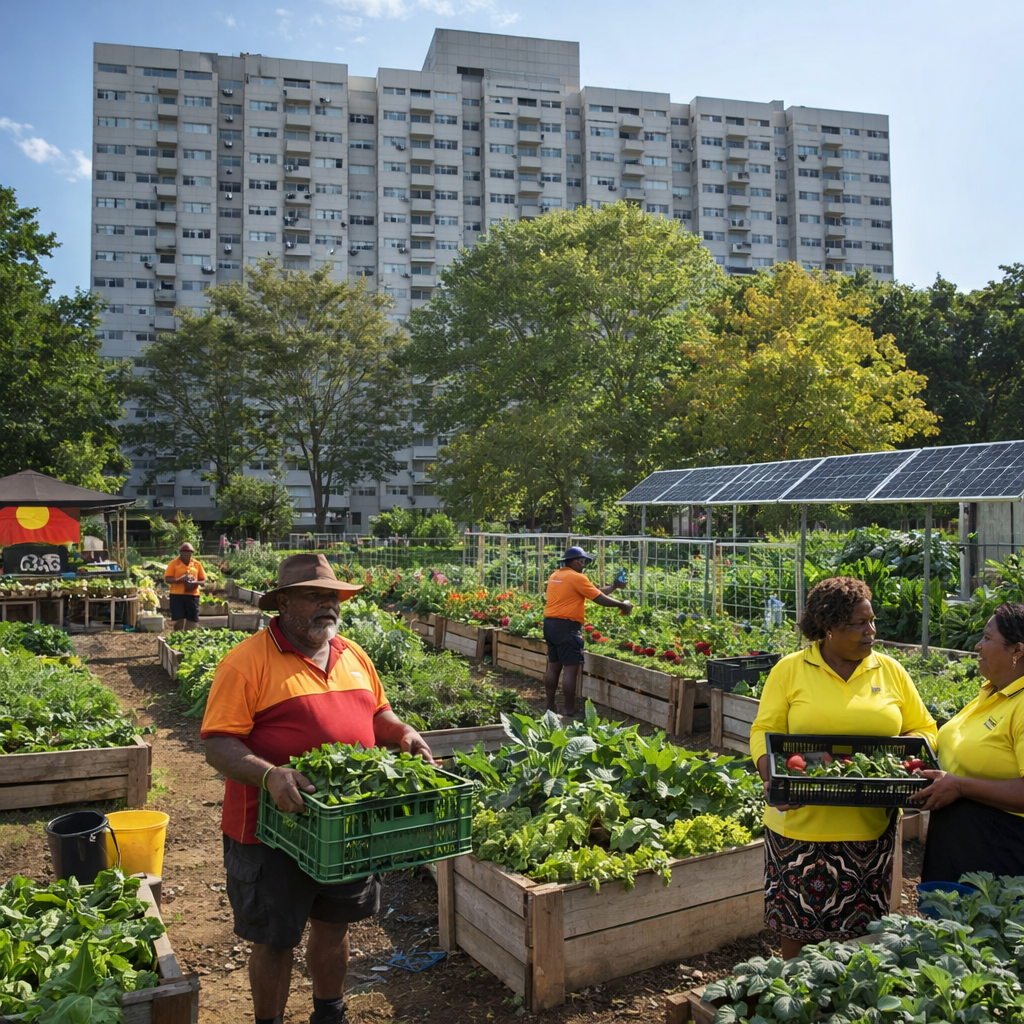
Commercial urban farming models designed to create employment, improve food access, reduce waste, activate underused land, and support local micro-economies.
Our vision includes productive use of public housing land, rooftops, unused urban sites, community spaces, and overlooked buildings to create food, work, training, connection, and local economic participation.
Food production is not just environmental infrastructure. It is social infrastructure.
-
Alternatives to crisis-driven systems that focus on early support, social connection, practical help, accountability, and community-led intervention.
We are interested in models that reduce pressure on policing, prisons, child protection, emergency housing, hospitals, and overloaded service systems by addressing harm earlier and closer to community.
Prevention is not soft. Prevention is infrastructure.
-
Commercially disciplined projects that create income, employment, ownership pathways, and measurable social return.
The Social Sustainability Project is developing enterprise models that are designed to be practical, investable, scalable, and locally grounded.
We are not building charity dependency. We are building participation, productivity, ownership, and repair.
-
The Bigger Vision
Together, these initiatives form a new model of social sustainability: one that treats community infrastructure, lived experience intelligence, food security, employment, technology, prevention, and enterprise as connected parts of the same system.
We are building the practical architecture for a future where communities are not simply managed through crisis, but resourced to become strong enough that crisis becomes less inevitable.
This is the investment space we believe Australia can no longer afford to ignore.

Our Founder
Holly Czinke spent 25 years in business working in some confrontational and "hectic” environments. After family formation with a man from a long term Sydney crime family, our life was amazing, privileged & upon reflection completely unsustainable…
Why Social Sustainability Matters
Social harm is expensive.
When communities are under-resourced, the cost does not disappear. It shows up elsewhere — in policing, courts, prisons, child protection, emergency housing, hospital systems, mental health demand, disability support, welfare dependency, domestic violence responses, addiction services, and long-term intergenerational trauma.
We estimate that failures in the community care sector may be contributing the equivalent of 15–25% of our effective tax burden, depending on how different crisis costs and support-system failures are modelled.
That means social sustainability is not just a moral issue.
It is an economic issue.
It is a productivity issue.
It is a public-interest issue.
It is an infrastructure issue.
Our Investment Proposition
We are seeking partners who understand that prevention is not charity.
Prevention is infrastructure.
The Social Sustainability Project offers partners the opportunity to support and participate in a new class of public-interest investment: projects that combine commercial potential with measurable social repair.
We are looking for partners across:
investment
philanthropy
social enterprise
research
universities
local government
ethical development
technology
food systems
housing
community services
impact measurement
public-interest law and policy
We are especially interested in partners who are prepared to support brave, practical, evidence-informed work that does not simply reproduce the same systems that created the harm.
Our Investment Proposition
We are seeking partners who understand that prevention is not charity.
Prevention is infrastructure.
The Social Sustainability Project offers partners the opportunity to support and participate in a new class of public-interest investment: projects that combine commercial potential with measurable social repair.
We are looking for partners across:
investment
philanthropy
social enterprise
research
universities
local government
ethical development
technology
food systems
housing
community services
impact measurement
public-interest law and policy
We are especially interested in partners who are prepared to support brave, practical, evidence-informed work that does not simply reproduce the same systems that created the harm.
Who We Want to Work With
We are seeking partners who are:
serious about structural change
willing to invest in prevention
open to lived-experience leadership
commercially realistic
socially courageous
interested in measurable impact
prepared to build new models, not just fund old ones
aligned with community ownership and public-interest outcomes
We are not looking for symbolic partnerships.
We are looking for people and organisations ready to build.
Why Now?
The old model is failing.
Communities are being asked to survive rising costs, housing stress, family breakdown, service fragmentation, criminalisation, social isolation, and institutional mistrust — while governments continue to pour money into crisis response.
We believe the future belongs to models that can do three things at once:
Reduce harm
Create economic participation
Return power to communities
That is the work of social sustainability.
And that is the work we are here to do.
Partner With Us
The Social Sustainability Project is ready to work with aligned partners to fund, test, build, and scale practical solutions.
We invite investors, researchers, councils, ethical businesses, universities, philanthropists, social enterprises, and community leaders to connect with us.
Together, we can move beyond managing crisis.
We can build the infrastructure for repair.
Social Sustainability is the next investment space.
The question is who is brave enough to build it with us.
Let’s Work TogetherIf you're interested in working with us, complete the form with a few details about your project. We'll review your message and get back to you within 48 hours.